
Do More EV Charging Stations Always Require More Electrical Capacity?


As electric vehicles become increasingly widespread, charging infrastructure is becoming more important for businesses, parking facilities, shopping centers, and commercial properties.
However, companies planning to expand their charging infrastructure often face an important question:
How many electric vehicles can our existing electrical infrastructure charge simultaneously?
At first glance, the solution may seem straightforward. Charging more vehicles might require greater electrical capacity, larger transformers, or additional infrastructure investments.
But is it possible to serve more vehicles simply by making smarter use of the capacity already available?
This is where Dynamic Load Balancing (DLB) comes into play.
The Challenge: What Happens When Everyone Wants to Charge at the Same Time?
Imagine a business with two electric vehicle charging stations in its parking area.
Let's assume each station can deliver up to 60 kW of charging power.
When both vehicles request maximum charging power simultaneously, the total demand becomes:
60 kW + 60 kW = 120 kW
However, suppose the facility has only 100 kW of electrical capacity available for EV charging.
In this case, the total demand exceeds the available capacity.
With a conventional approach, the business might limit charging power to a fixed level or consider upgrading its electrical infrastructure.
However, neither option is necessarily the most efficient solution.
Not every vehicle charges at maximum power continuously. Energy requirements, charging durations, and the number of vehicles using the stations change throughout the day.
Therefore, the real challenge is not simply the total available capacity, but how that capacity is distributed among vehicles.
What Is Dynamic Load Balancing?
Dynamic Load Balancing is a method of automatically adjusting the power allocated to charging stations according to changing conditions and the available capacity of the electrical infrastructure.
Its purpose is to make efficient use of existing capacity without exceeding defined electrical limits.
Let's return to our previous example.
Two vehicles are requesting a combined 120 kW of power, but only 100 kW is available.
Under suitable technical conditions, a Dynamic Load Balancing system could distribute the power as follows:
Vehicle 1: 60 kW
Vehicle 2: 40 kW
Total: 100 kW
This allows both vehicles to continue charging simultaneously without exceeding the available electrical capacity.
Furthermore, when one vehicle finishes charging or reduces its power demand, the freed-up capacity can be allocated to the other vehicle.
The key point is simple:
The system does not create additional electrical capacity. It makes better use of the capacity that already exists.
What Happens When the Building's Electricity Consumption Changes?
This is where Dynamic Load Balancing becomes particularly valuable.
EV charging stations are rarely the only electricity consumers within a facility.
Lighting, heating and cooling systems, production equipment, elevators, and other electrical systems may all share the same infrastructure.
For example, imagine a facility with a total permitted power limit of 200 kW.
When the building consumes 100 kW, theoretically 100 kW remains available for EV charging.
However, if the building's consumption increases to 140 kW later in the day, the available charging capacity decreases to 60 kW.
A Dynamic Load Balancing system monitors these changes and adjusts the charging power accordingly.
When building consumption decreases, more power can be allocated to vehicles. When consumption rises, charging power can be reduced to help maintain electrical limits.
This allows EV charging operations and the building's other electricity requirements to be managed in coordination rather than independently.
These examples are simplified for illustrative purposes. Real-world implementations must also consider phase-specific limits, equipment capabilities, vehicle charging limitations, and electrical safety requirements.
Static vs. Dynamic Load Balancing: What's the Difference?
Not all load balancing systems operate in the same way.
Static Load Balancing uses a predefined power limit for EV charging stations. This capacity can be distributed among stations, but changes in the building's actual electricity consumption may not be automatically considered.
Dynamic Load Balancing, on the other hand, uses measurement data to continuously adjust the available charging power according to changing conditions.
For example, electricity consumption at a shopping center might be relatively low in the morning but increase significantly during the evening.
A fixed charging power limit may not always make efficient use of these variations.
Dynamic systems can adapt charging capacity to the building's actual electricity demand.
Under suitable conditions, this helps maintain electrical limits while reducing the amount of available capacity left unused.
Is Distributing Power Equally Always the Best Approach?
Not necessarily.
Consider two vehicles charging simultaneously in a parking facility.
The first vehicle will leave in two hours and needs 30 kWh of energy.
The second vehicle will remain parked for six hours and needs 20 kWh.
Although distributing power equally is possible, it may not produce the best outcome.
The reason is that vehicles differ not only in their power requirements but also in how much energy they need and when they must be ready to leave.
This introduces an important distinction between load balancing and smart charging optimization.
Load balancing primarily focuses on maintaining electrical capacity limits and distributing available power.
Smart charging optimization can go further, considering questions such as:
Which vehicle should complete charging first?
Which vehicle has greater flexibility in its departure time?
During which hours should charging power be increased or reduced?
How should electricity prices and the facility's other energy requirements influence charging decisions?
With suitable data and control capabilities, the system can move beyond simply distributing available power and create a charging schedule that better reflects different operational needs.
Can Dynamic Load Balancing Also Reduce Energy Costs?
The primary purpose of Dynamic Load Balancing is not to directly reduce electricity prices.
However, when combined with energy management and optimization systems, it can create economic benefits.
First, using existing electrical capacity more efficiently may reduce or postpone the need for infrastructure upgrades at certain facilities.
Additionally, coordinating EV charging with periods of high facility power demand can help manage demand-related electricity costs, depending on the applicable tariff and contractual conditions.
Where electricity prices vary over time, another optimization opportunity emerges.
For example, if a vehicle remains parked for four hours but requires less time to receive the necessary energy, charging does not necessarily have to take place entirely during the most expensive hours.
With an appropriate charging schedule, part of the electricity consumption can be shifted to lower-cost periods.
In this context, two different objectives work together:
Dynamic Load Balancing: Safely and efficiently distributing the available electrical power capacity.
Energy Optimization: Improving charging schedules and power allocation from an economic perspective while meeting operational requirements.
These approaches complement each other. However, Dynamic Load Balancing systems do not automatically perform electricity price optimization unless they are designed to do so.
Can Solar Energy and Battery Storage Be Integrated?
Yes.
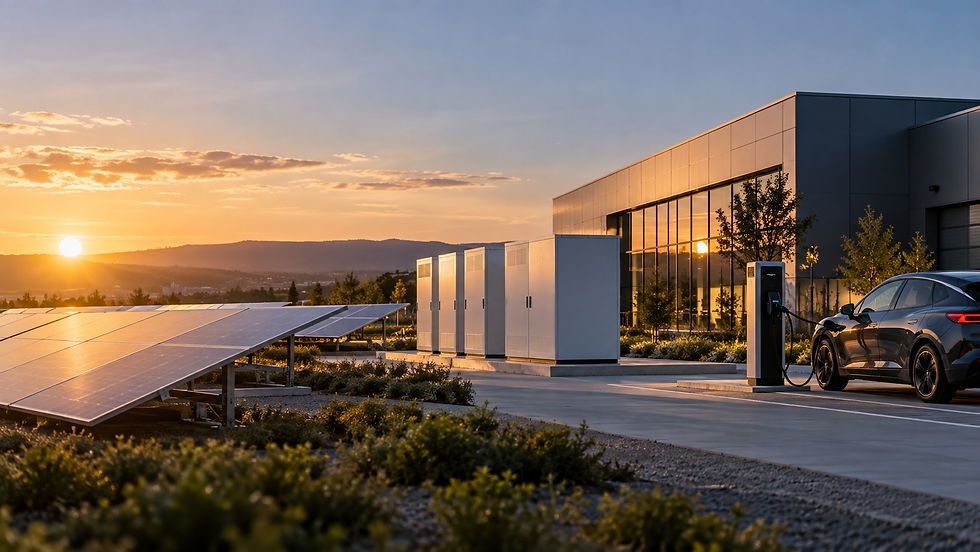
Facilities equipped with EV charging infrastructure may also have solar photovoltaic (PV) systems or battery energy storage systems.
For example, electricity generated by solar panels during the day can be used to charge electric vehicles when conditions allow.
A battery storage system may also help supply part of the charging demand or limit the power drawn from the electricity grid during certain periods.
However, this introduces additional decisions.
Should solar electricity be consumed immediately? Should it be stored in a battery? At what times should electric vehicles be charged?
When these decisions are evaluated together, energy management extends beyond simply distributing power among charging stations.
EV charging infrastructure becomes part of the facility's overall energy system.
The Role of Software in Smart Charging Management
Measurement, communication, and control technologies play an essential role in Dynamic Load Balancing and smart charging applications.
For example, the Open Charge Point Protocol (OCPP) enables standardized communication between charging stations and central management systems.
Depending on the supported protocol version and implemented features, it may be possible to limit charging power or apply predefined charging profiles.
However, supporting a communication protocol alone is not sufficient.
Effective load balancing also requires reliable measurement data, appropriate control capabilities, correctly defined electrical limits, and safe operating mechanisms.
FlexyWatt's FlexyCharge approach aims to bring charging station management and energy optimization together.
By leveraging FlexyWatt's forecasting and optimization technologies, the objective is to plan charging operations not only according to immediate power requirements but also by considering electricity prices and operational needs.
This approach aims to transform EV charging infrastructure from a standalone system into an integrated component of a broader energy management strategy.
Do More Charging Stations Always Require Bigger Infrastructure?
Not always.
At some facilities, existing electrical capacity can support additional charging points through appropriate load balancing and charging schedules.
However, this does not apply to every situation.
Total energy requirements, vehicle parking durations, simultaneous charging demand, available electrical capacity, and technical safety limits must all be evaluated together.
For example, if every vehicle needs a large amount of energy within a very short period, software-based optimization alone may not be sufficient.
Therefore, the right question is not simply:
"How many charging stations can we install?"
But rather:
"How many vehicles can we serve with our existing electrical capacity, under what conditions, and how can we manage that capacity most effectively?"
Conclusion
The expansion of EV charging infrastructure requires more than simply installing additional charging stations. It also requires smarter management of the electrical capacity already available.
Dynamic Load Balancing helps distribute limited power among charging stations according to changing requirements, while smart charging optimization can incorporate scheduling and economic considerations into the process.
In the future, the value of charging infrastructure will not be determined solely by the number of charging stations or the total installed charging capacity.
The real value will come from how intelligently, efficiently, and collaboratively that capacity is managed.

Comments